Our next stop was the small town of Carterton, home of our friend Tim. Tim is from New Zealand, but came to Canada to do his Masters degree in January of 1998 – where he immediately had to evacuate his apartment and move into a shelter because of the 1998 ice storm. Greg was doing his PhD at the time, in the same lab with the same supervisor, and we all became fast friends. We’ve stayed in touch over the years, but hadn’t actually seen each other since 2000, so this was a long-overdue reunion.
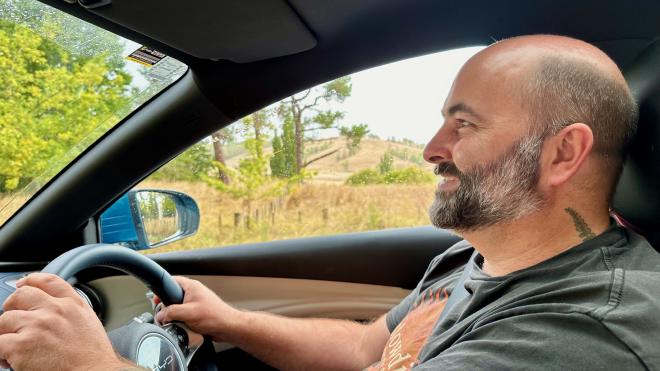
We took a bus from Stratford back to Palmerston North, where Tim met us in his recently acquired BYD Atto 3 electric SUV. After excited hellos and hugs we hopped in for the drive south.
As we were leaving Palmerston, Tim asked whether we’d managed to see a Kiwi (bird) yet on our visit to New Zealand. When we said no, he suggested we stop at the Pukaha National Wildlife Centre in Opaki, which was just a little out of our way, for lunch and a visit.
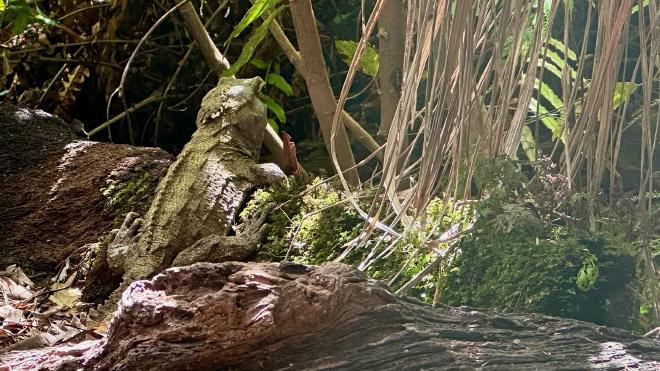
The wildlife centre houses a wide variety of birds and animals. This is a Tuatara, a reptile that exists in the fossil record going back at least 90 million years, making it a contemporary of the dinosaurs. Young Tuatara have a pineal “third eye” on their forehead that is sensitive to ultraviolet light. As the reptile ages, this becomes covered with scales. Its purpose is still not well understood.
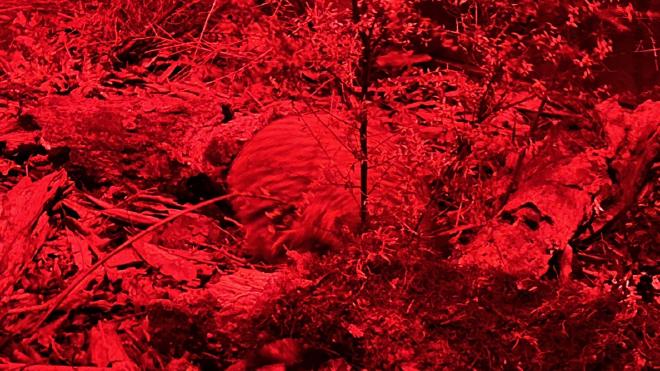
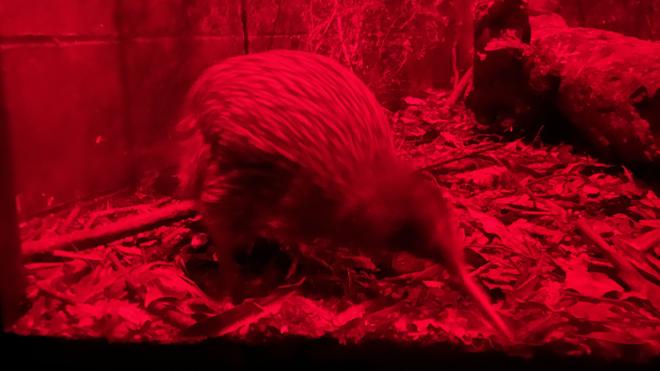
Kiwi are nocturnal and quite shy, so they’re kept in a special glassed enclosure with red light in the daytime and brighter light at night, to flip their schedule and let the visitors see them. But not very well: the stripy smudge in the middle of this picture was about the best look we got during ten minutes in the Kiwi house.
Here’s a better picture that Tim gave us, which he took on a previous visit with his kids. (TW)
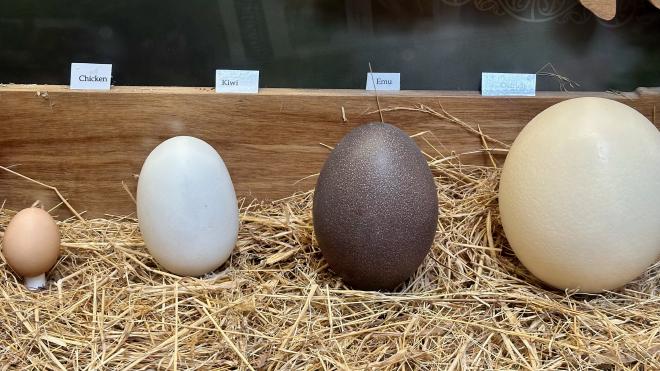
The Kiwi is not a large bird, but it does lay large eggs!
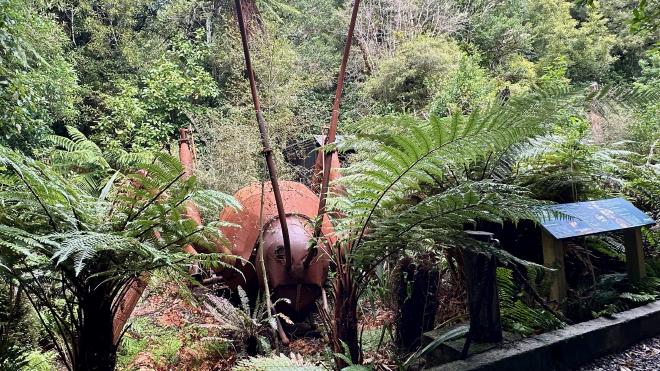
This is a Wētā, a native New Zealand insect somewhat similar to a grasshopper. But they’re not actually quite that large; this is a 100:1 scale metal sculpture.
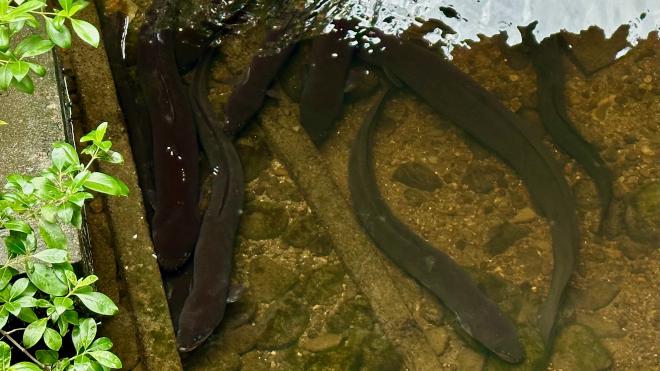
A stream at the centre is home to New Zealand longfin eels, who were looking very cuddly during our visit. These migrate to the ocean and as far north as Fiji to spawn, with the new generation returning to the same streams their parents came from.
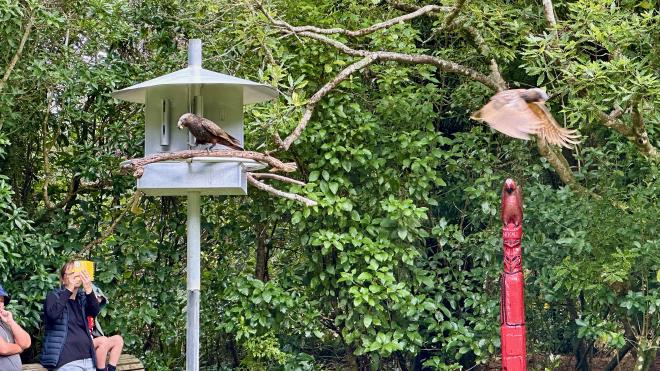
There are bird enclosures all over the centre, but they’re densely treed and it’s rare to actually see a bird. However, the centre is also home to a population of free-flying Kākā and our visit included their daily feeding time. Kākā are one of the largest species of New Zealand parrots and are found throughout the Islands. When sitting still they’re quite drab, but the undersides of their wings are brightly coloured. The red pole is a memorial to Nikau, a popular Kākā who passed away several years ago.
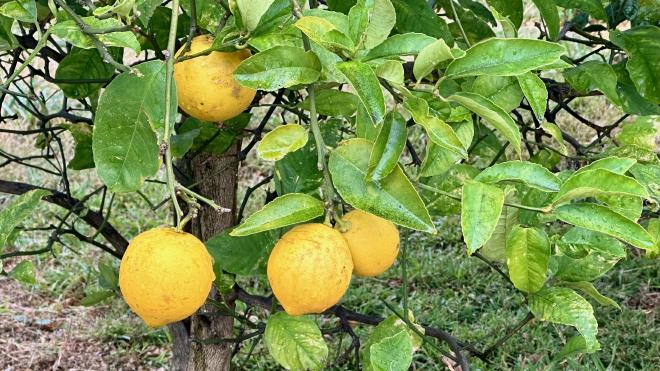
From the centre we drove back to Tim’s house. This lemon tree is part of a small orchard that Tim planted in his front yard – and which he’s shortly going to miss, as he’s in the process of selling his house in order to move closer to Wellington and his kids’ school.
That evening we were invited to a large family dinner at Tim’s Dad’s place, also in Carterton. In addition to Tim’s Dad, we got to meet Tim’s sister and her husband, their two kids, and Tim’s brother-in-law’s parents, who were visiting from California. The food was excellent, as was the drink – which included some calvados that Tim’s Dad had distilled himself. He said it wasn’t properly aged yet, but it tasted pretty good to us.
Tim had excursions planned for the next day, but they were all outdoors and derailed by an extremely wet and windy morning. So, we didn’t get to see the Stonehenge Aotearoa, among other things. Maybe next time.
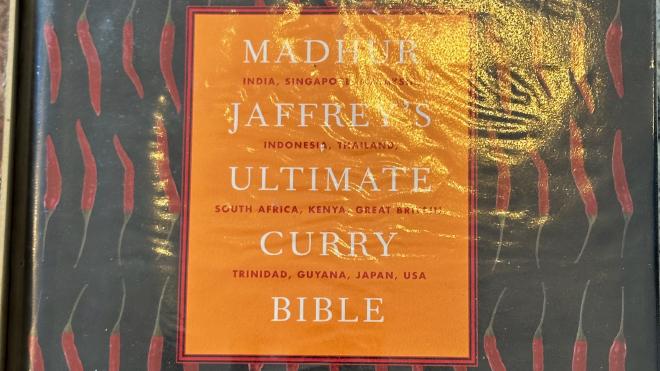
We spent the morning and early afternoon attempting to fix a broken pot light in Tim’s kitchen (he ultimately had to call in an electrician, after we’d left), catching up on the last twenty-five years, getting some groceries for dinner, and talking about cooking. Greg and Tim also spent some time talking about the nerdy aspects of Tim’s work, which is on internal tooling for Microsoft’s Azure cloud service. Tim has an extensive cookbook collection, including the full set of Nathan Myrvold’s nerdy cooking volumes. This curry cookbook is one of his favourites, and we’re planning to buy it when we get back home.
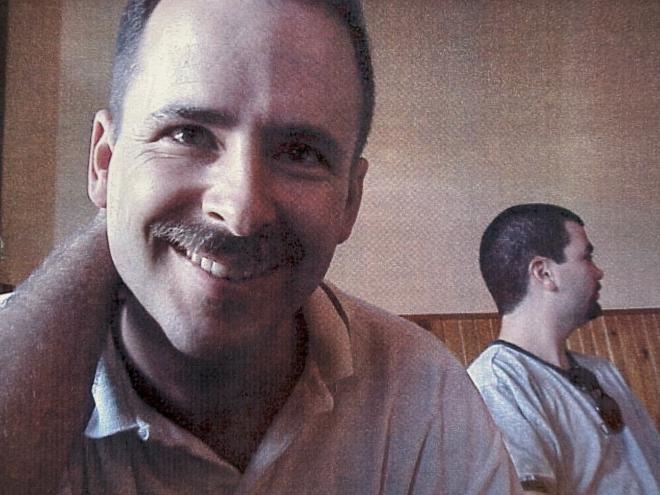
Tim also dug through his photos from his time in Canada and came up with this gem. Yes, that’s a much younger and beardless Greg looking at the camera. In the background is Gary, the third student in our supervisor’s lab group at the time. We’re pretty sure the venue was the Queen’s University Grad Club.
By late afternoon the rain had mostly blown past, ’though the wind was still gusting strongly. We decided an outing was in order and headed to Castlepoint on the east coast.
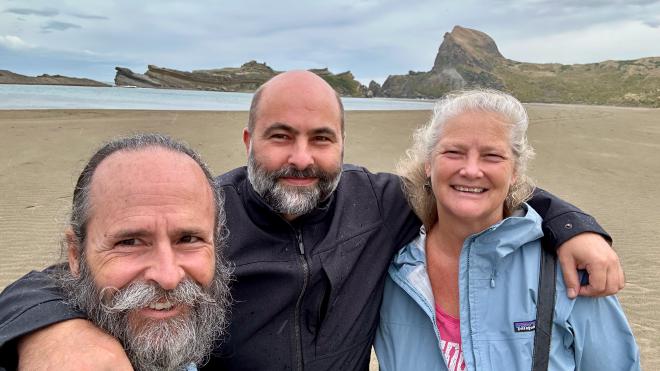
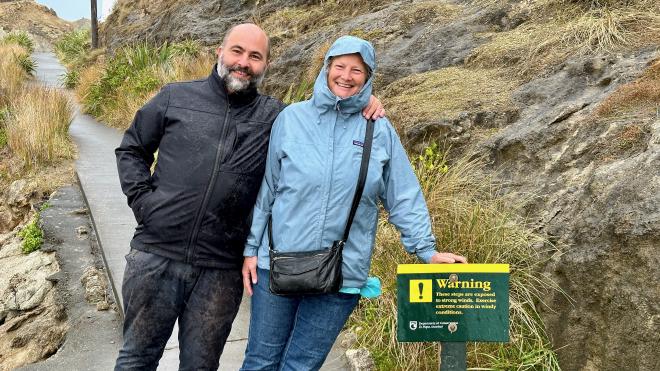
The large rock behind Karen is Castle Rock, which is apparently a nice but challenging hike, at least when it the wind isn’t gusting too strongly. But it was, so we didn’t.
See? It was too windy for Karen and Tim to stand up straight!
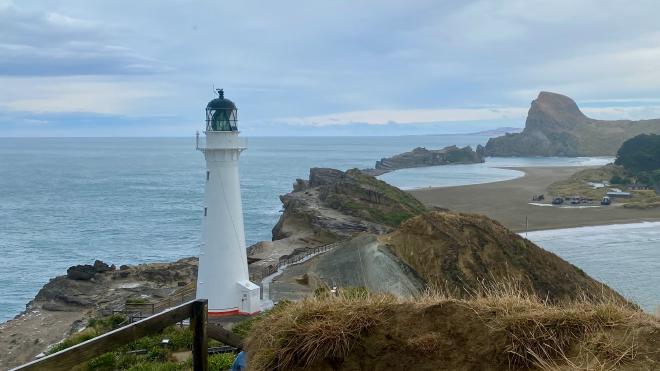
We walked up the path to the lighthouse, which gave us another view of Castle Rock.
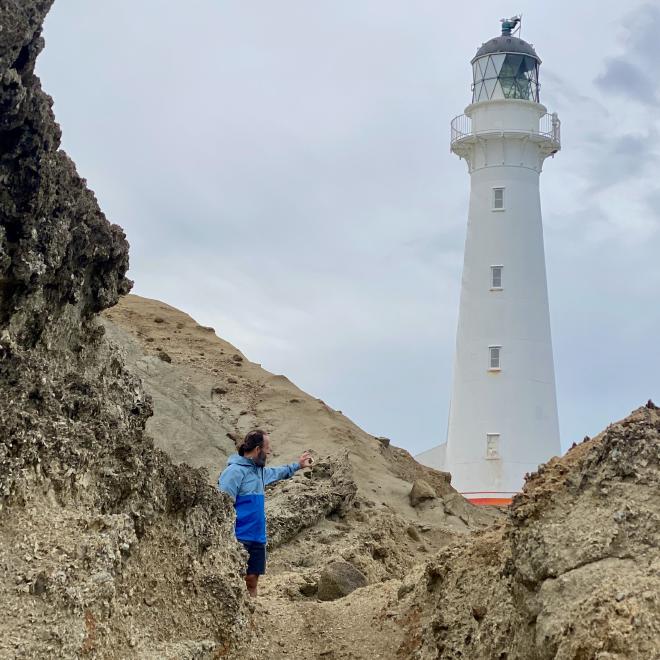
Walking back from the lighthouse Greg found something.
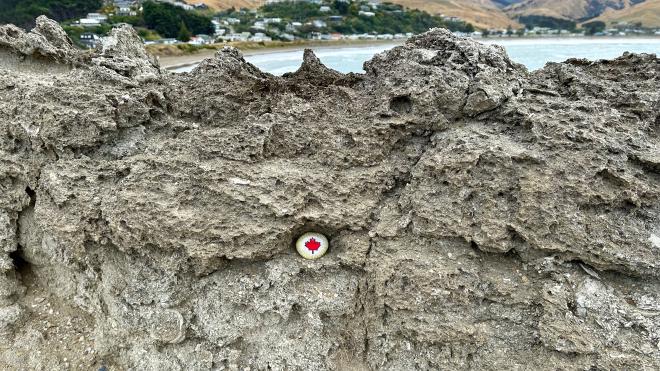
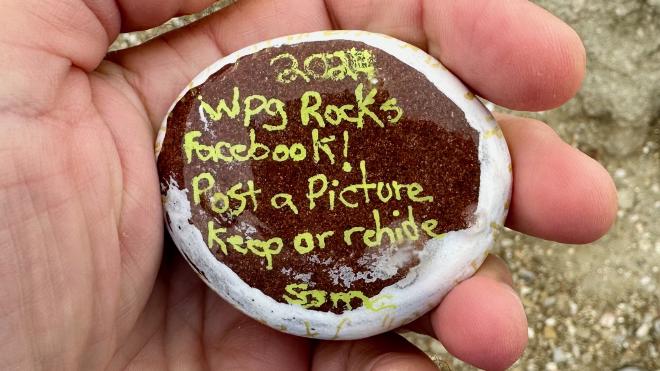
A small stone painted with a maple leaf…
… and a message from Sam from Winnipeg on the back. We put it back for someone else to find.
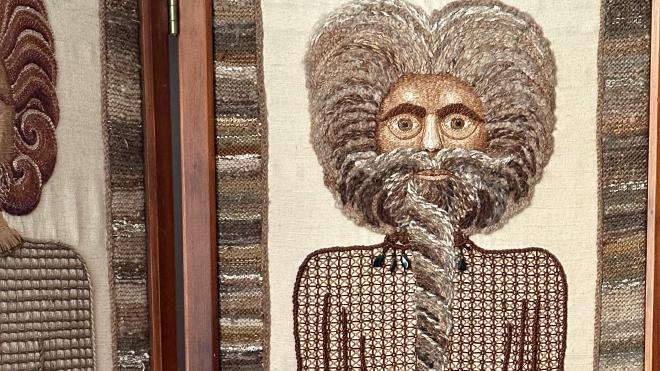
Then it was back to Tim’s place. This portrait of Greg was on a privacy screen in Tim’s bedroom, which he insisted we use during our stay.
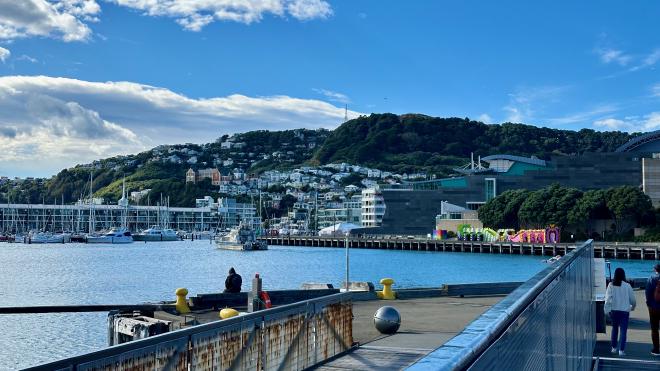
Tim had a friend’s funeral to attend the next morning, and we had plans together in Wellington for the afternoon, so Tim dropped us off at a train station and we headed in to the city. This is a view of Wellington harbour from near the main train station.
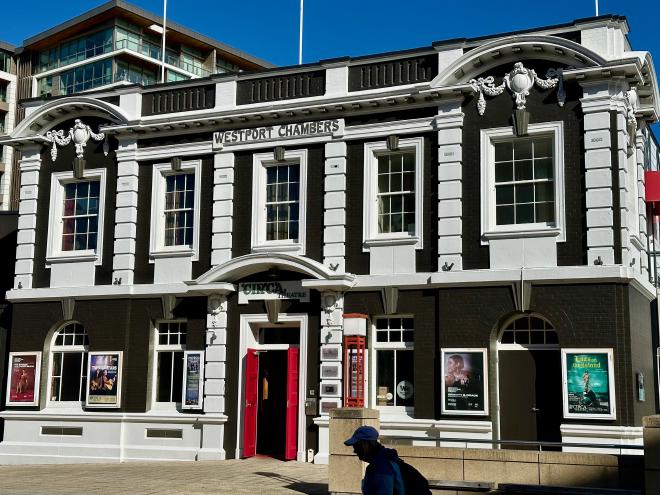
Wellington is New Zealand’s capital city and has an interesting mix of colonial and modern architecture. This building was originally the Westport Chambers (town hall) and has been repurposed as a theatre.
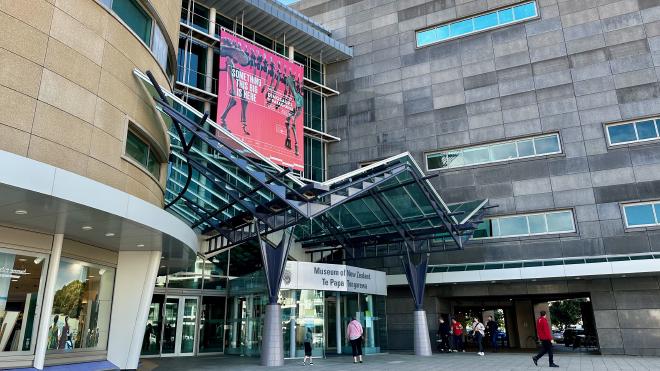
Our destination for the morning was the Museum of New Zealand Te Papa Tongarewa, commonly known as Te Papa. It’s an enormous museum, with free admission except for the special exhibit – which was about dinosaurs while we were there, so we skipped that.
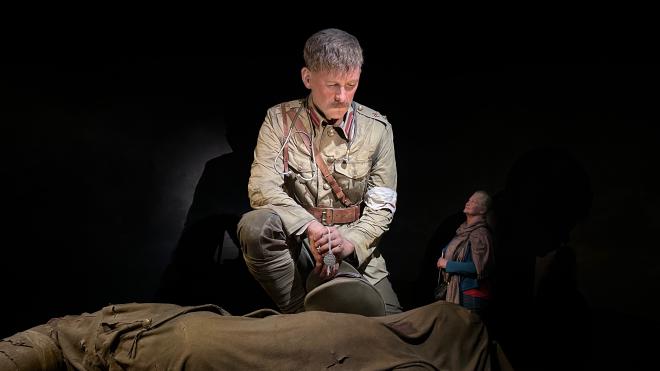
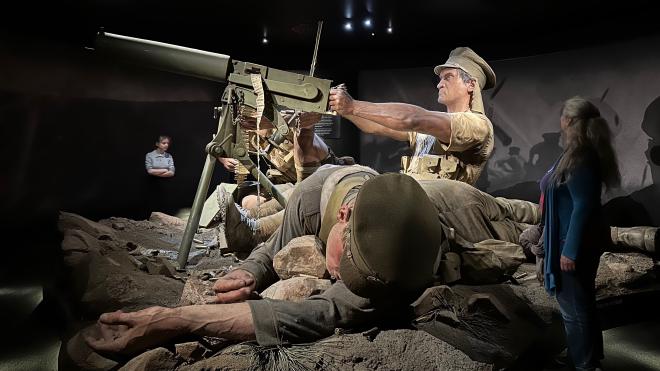
One of the permanent exhibits is Gallipoli: The Scale of Our War, which tells the story of New Zealand’s involvement in the ill-fated Gallipoli campaign in World War I. Besides the informational displays, the exhibit features extremely large and lifelike sculptures recreating specific incidents from the campaign.
The sculptures were created by Wētā Workshop, best known for their work on physical and digital props and costumes for the Lord of the Rings and Avatar movies. The enormous scale and incredible realism of the sculptures makes a powerful emotional impact.
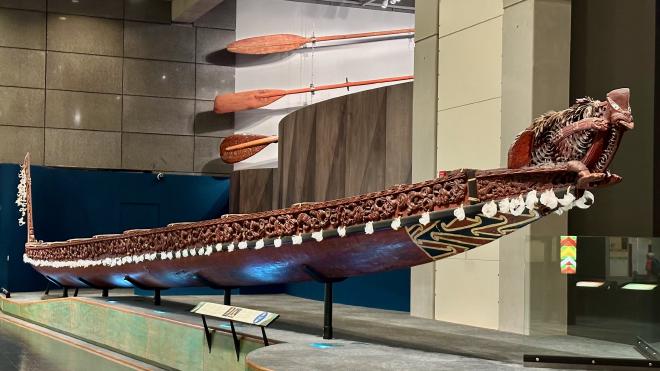
A large exhibit on the second level tells the story of the Māori peoples, both before and after the arrival of the Pākehā (Europeans). Based on both oral histories and archaeological evidence, the first Māori are believed to have arrived in New Zealand about 1280 CE with settlment beginning around 1320. The first Pākehā explorer, Abel Tasman, visited the Islands less than four hundred years later in 1642 and European settlement commenced in the early 19th century. This is Teremoe, a Māori waka (canoe) carved from a single tree and used in the 1860’s in the war against the Pākehā government. It was later used as a trading vessel. On the wall behind Teremoe are steering paddles for large waka.
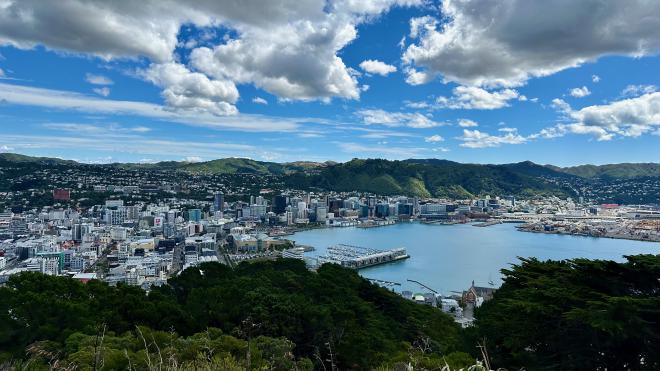
Tim pinged us while we were in the Māori section, so we left to join him for lunch near his office. Then he drove us up to the Mount Victoria lookout in Charles Plimmer Park, from which we had spectacular views of the harbour and surrounds.
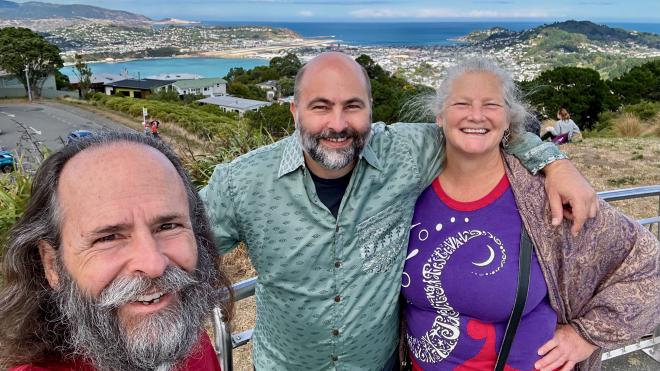
Here’s a slightly different view, with three happy folks blocking the scenery.
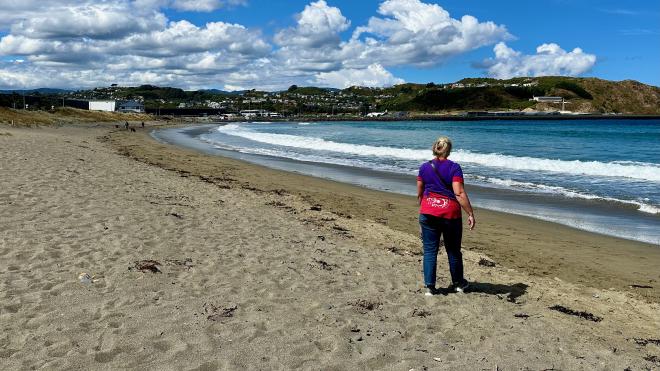
From Mount Victoria we drove around the coast, stopping briefly at Lyall Bay for a wander on the beach. The low-lying area just past Karen is the airport, which is built on reclaimed land.
We continued along the shoreline to Scorching Bay, where we stopped at the Scorch-O-Rama Cafe.
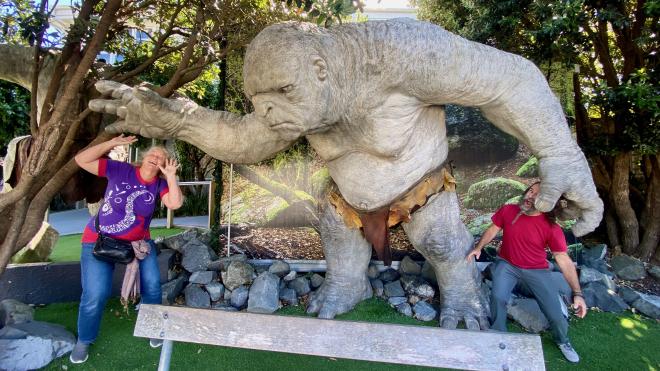
Our main destination for the afternoon was the Wētā Workshop, for a tour that gives a glimpse of where the prop-making magic happens. This troll outside the building attacked the two of us.
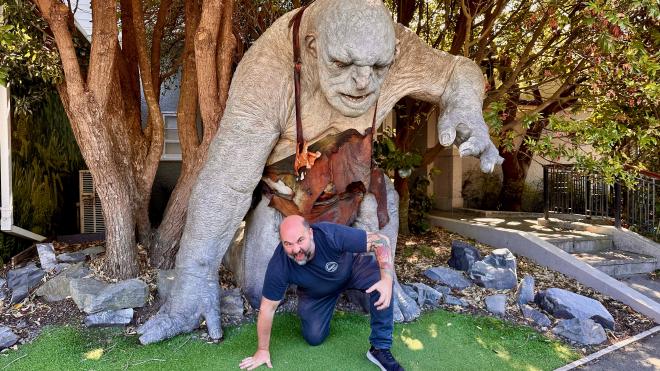
Tim wasn’t attacked, because he is, himself, a troll.
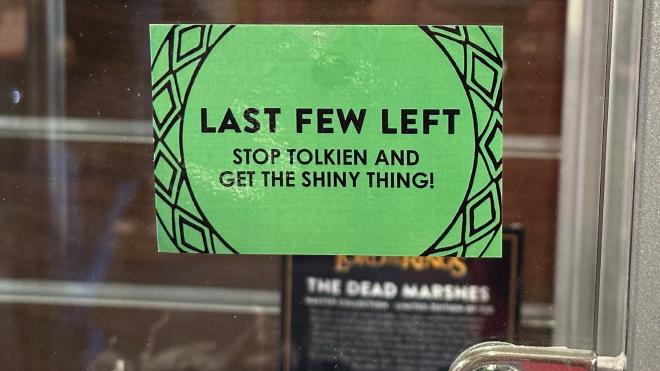
As you might expect, the Workshop has an extensive gift shop, offering all kinds of memorabilia from films whose props have been made there. And bad puns, which were free. We wandered through while waiting for our tour time.
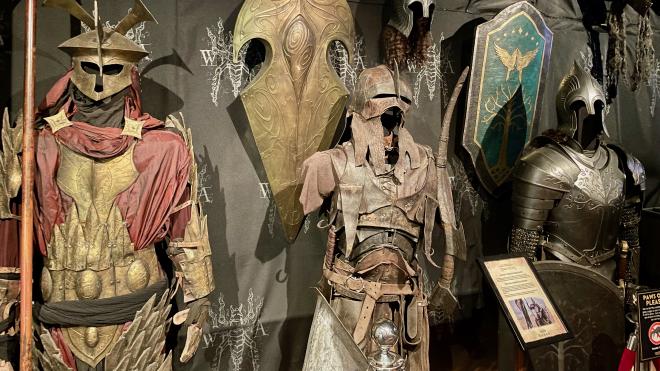
These suits of armour, displayed in the shop, are actual props from the Lord of the Rings movies – display only, not for sale.
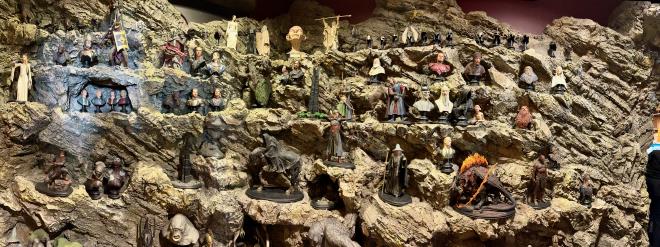
However, most of these figurines were for sale, elsewhere in the shop.
And now the bad news: photography wasn’t allowed on the tour, for what we were told are “intellectual property” reasons. Personally, we think they’re just camera-shy. Whichever is true, we don’t have any pictures of the tour to show you.
The tour included a brief film about the history of Wētā, and how it went from a very small kitchen-table operation to a large and thriving company, largely due to Peter Jackson hiring Wētā to make the props for his Lord of the Rings movies.
There was a room entirely dedicated to prosthetic makeup, where we got to handle samples of all the stages of creation of a full-head mask. There was also a video showing the techniques that go into making each stage, as well as how the final product is applied.
Another room had samples we could handle of many of the different technologies Wētā uses, from silicone castings to animatronics to textiles to hair.
And another room had a large collection of real props from the Lord of the Rings and Hobbit films, Avatar, Narnia, and District 9, among others. Through a window from that room we could see an enormous computer numerically-controlled mill carving out a large sculpture, and we also had a view into a blacksmith workshop where blades were being made.
All the while our tour guide, whose main job for Wētā is voice acting, was telling stories about the things we were seeing and answering questions. Overall, the tour was a lot of fun and we’d definitely recommend it if you have any interest in how movies are made.
Besides the no-photography rule, the only disappointment was that we didn’t see any current work in progress, other than our distant view of the blacksmith shop. This isn’t really surprising: the work Wētā is doing now is on films that don’t exist yet, and the movie industry is incredibly secretive.
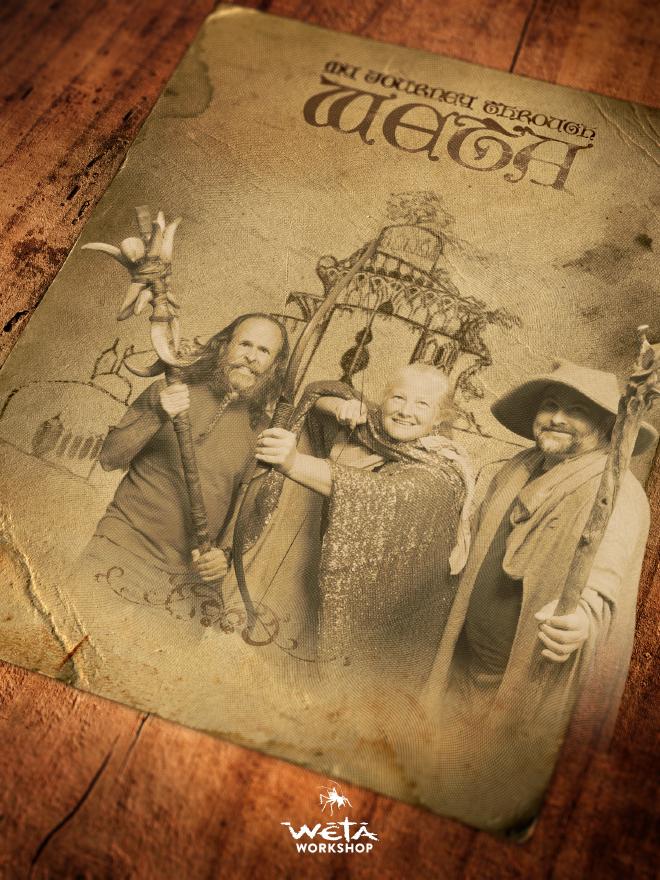
In the last room of the tour, each group was invited to pose in front of a green screen with some props and costumes. Afterwards we had an opportunity to purchase the photographs, put on a variety of backgrounds from films Wētā has worked on.
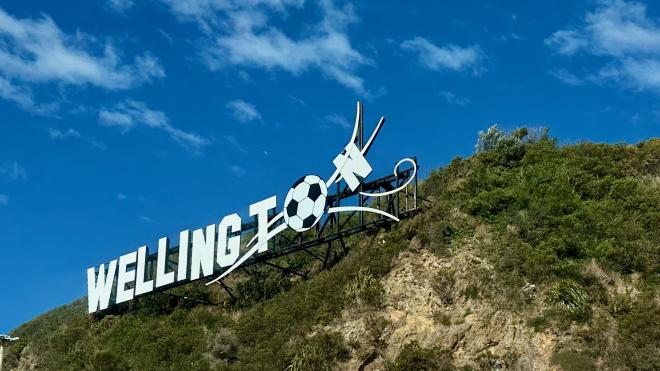
Driving out of town we passed the Wellington Blown Away sign. This was originally intended to be a “Wellywood” sign, as an homage to the famous Hollywood sign, with a nod to Wellington’s role as New Zealand’s film industry capital. However, some people weren’t too thrilled with it, including the Hollywood Chamber of Commerce, which threatened to sue. Ultimately the change to “Wellington” and addition of a bit of wind, which Wellington is famous for, calmed everyone down. The football is temporary, promoting the 2023 FIFA Women’s World Cup.
From there, we picked up Tim’s kids from their mother’s house and the five of us went out for a delicious Indian dinner. Then, after dropping the kids off again, we headed to Johnsonville, on the north end of Wellington, where we were staying the next few nights with Graham and Em.
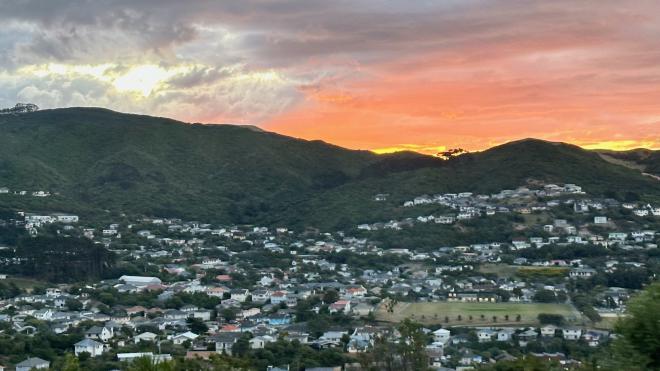
We arrived around sunset and were treated to this amazing view from the back of Graham and Em’s place, on the side of a hill.
Thanks again to Tim for a terrific visit and for looking after us so well. Next time, let’s not wait a quarter century to get together!